
Chronic stress treatment in Zurich
Support for a nervous system stuck on high alert
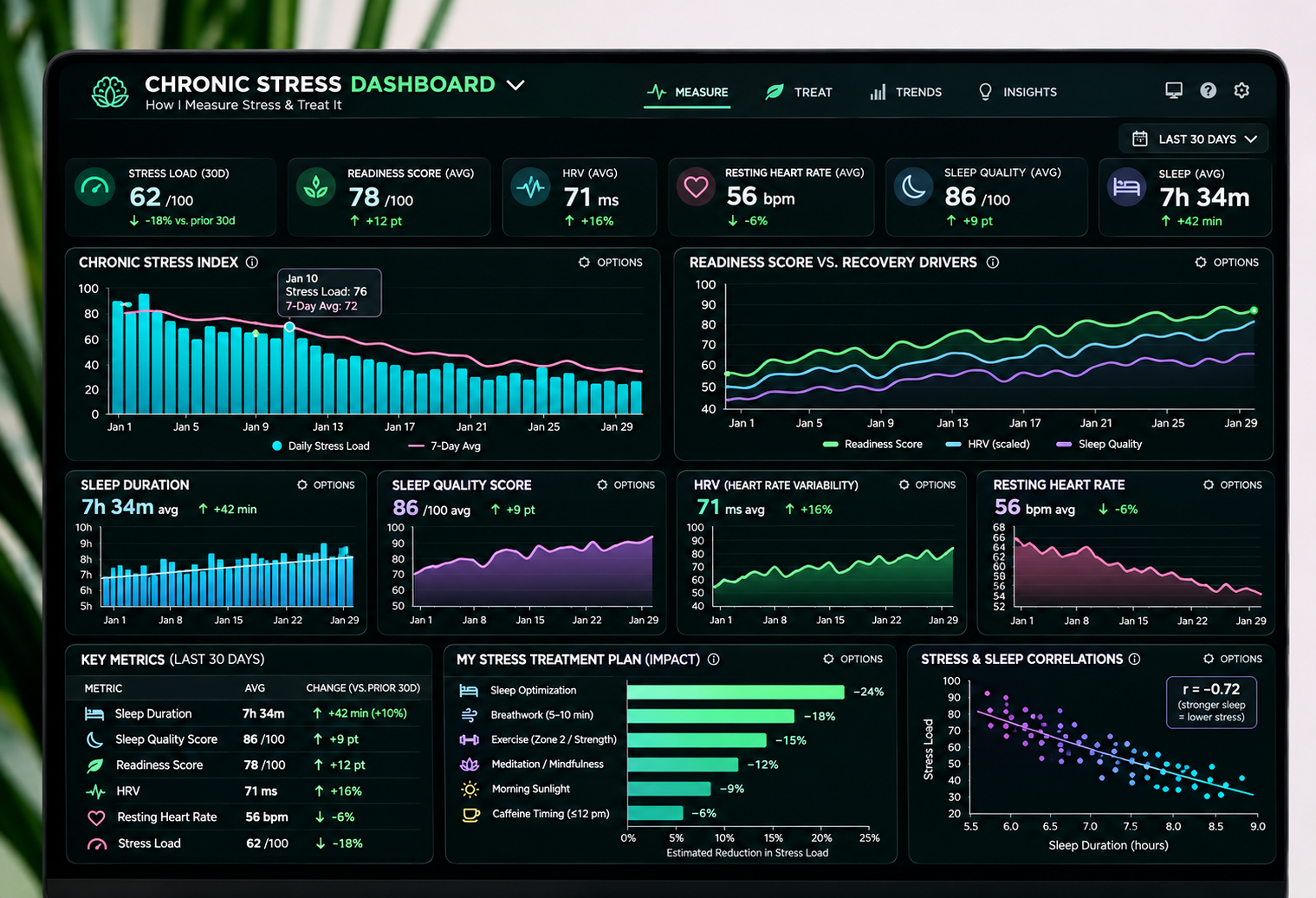
Stress itself isn’t the problem. It’s what helps you meet a deadline, win a point, get through a hard day. The problem is a system that doesn’t come back down afterwards. That’s chronic stress, and it’s measurable and treatable. I start by finding out what’s actually happening in your body.
Tjade Tieltjes, neuroscientist
In person in Zurich or online · About me

Do you recognise this?
Wired, but exhausted. Awake at 5am for no reason, mind already racing. Snapping at something small that wouldn’t normally bother you. Headaches, stomach issues or joint pain that don’t trace back to anything obvious.
When you’re under pressure, big or small, your body redirects energy towards “fight or flight” and away from other systems: digestion, tissue repair, reproduction, even creative thinking. Each of those deprioritised systems can end up carrying the cost of stress you may no longer consciously feel.
What chronic stress is, and isn’t
Most people think of stress as a feeling: vague, subjective, something you either have or don’t. Physiologically it’s much more specific. A stressor is anything that asks your body to adapt and mobilise energy. A deadline, a hard conversation, a tennis match, running for the tram: these are all stressors, and none of them is inherently bad. A short burst of high alert is exactly what gets you through difficult moments.
The real question is what happens afterwards. Can your system come back down once the demand has passed? If it can, stress is doing its job. If you’re still running hot hours or days later, that’s where chronic stress begins, and where it starts to cost you.
Think of it like a race car. Enormous top speed is only useful with equally strong brakes. A system built only for acceleration, with no way to slow down, is the dangerous part. Not the speed itself.
Signs of chronic stress
Chronic stress rarely shows up as one clear symptom. It tends to appear in three places, often long before you’d call yourself “stressed”:

On edge
Restless or on edge, heart palpitations, a shorter fuse than usual, and a mind that keeps racing, especially at night.

Sleep out of balance
Falling asleep the instant you lie down, or lying awake unable to switch off. Waking unrefreshed or too early, with brain fog during the day.
Body paying the price
Digestive issues, skin or joint flare-ups, or an existing condition such as type 2 diabetes getting worse. These systems aren’t damaged, just deprioritised, and often settle once the alert state does.
Why chronic stress keeps itself going
The pattern you might recognise
Chronic stress usually starts with a demanding stretch: a heavy workload, a life change, a period where more is asked of you than you can comfortably give. Sleep is often the first thing to give way. You go to bed later, or lie there with a mind that won’t switch off, and wake up less rested.
To compensate, you reach for more coffee. It helps for a few hours, then leaves you wired and restless, which makes the next night’s sleep worse. Bedtimes drift later. Exercise is usually the next thing to go, and with it time outdoors and daylight. Your mood starts to dip.
Running on empty, cooking feels like too much. You order in or reach for whatever’s easiest. Meals become irregular: breakfast skipped, snacking late at night. In the evening, winding down turns into scrolling, which pushes bedtime back even further. The next morning you start from a bigger deficit than the day before, and the loop continues.
What’s actually happening in your body
The same loop, from a physiological angle. Four systems feed into it, and into each other:
Stress systems: prolonged activation of the sympathetic nervous system and the HPA axis, which releases cortisol. Under sustained demand, recovery is deprioritised and your resilience gradually shrinks.
Sleep: short or fragmented sleep raises evening cortisol and makes your stress response more reactive the next day. Caffeine blocks adenosine, the molecule that builds sleep pressure, so you fall asleep later and sleep more lightly.
Circadian rhythm: your internal clock relies on regular cues called zeitgebers: morning light, movement, meal timing and social rhythm. When these weaken, sleep, energy and mood all become less reliable.
Metabolism and reward: late, irregular eating plus poor sleep is linked to lower insulin sensitivity and more sugar cravings. Low energy makes quick rewards like scrolling more appealing, and night-time scrolling keeps your nervous system aroused.
None of this is a failure of discipline
Every single step is a reasonable response to being tired and overloaded. That’s exactly why the pattern is so hard to see from the inside, and so hard to break alone. Seeing it clearly is where change starts.
How I support you
Sometimes a stretch of life genuinely demands more of you. How well you handle it depends largely on what came before: your capacity isn’t built in the week before a hard period, it’s built or depleted over months and years of habit.
For many people, everyday behaviour quietly drains their battery without them noticing. The goal usually isn’t to overhaul everything. It’s to see clearly where the drains are, so you know when to step back and prioritise recovery, and to map what actually recharges you so you can rely on it deliberately.
Body literacy: learning to read your own signals accurately
Identifying battery drains: the habits and patterns quietly costing you more than you realise
Mapping what recharges you, physically and psychologically
Habit architecture: sustainable routines that don’t rely on willpower
Biofeedback, to train your nervous system to shift gears again
Guidance on tracking and monitoring your own data
Lifestyle medicine: sleep, light, movement, nutrition and breathing
Coordination with specialists in my network, when your situation calls for it
Working alongside your doctor. I’m a neuroscientist, not a physician, so I don’t diagnose, prescribe medication or issue sick notes. I work alongside your GP, psychiatrist or therapist, not instead of them.
How it works
From the first call to lasting change, in five steps.
Free call
A short, no-pressure conversation to see whether this is the right fit.

Assessment
A structured interview, HRV and morning readiness testing, a 7-point diurnal cortisol profile and questionnaires, matched to your symptoms.

Your plan
Built around what’s actually driving your chronic stress.

Monitoring
I track how your system responds over time, in person or online.

Adjusting
Your plan evolves as your situation and capacity change.

Price: CHF 150 per session. Price for pre-determined process on request. The first call is free. Sessions are self-pay and not covered by basic or supplementary health insurance.
Frequently asked questions
-
A busy period ends, and your system comes back down with it. Chronic stress is when it doesn’t: you stay wired at night, wake up unrefreshed, react faster than usual, or notice physical symptoms weeks after the pressure has passed. The question isn’t how much is on your plate. It’s whether you still recover.
-
Not with a single number. One cortisol reading tells you very little, so I don’t rely on one. Instead I measure patterns: heart rate variability (HRV) as a marker of how well your nervous system recovers, a 7-point diurnal cortisol profile that maps your stress hormone rhythm across the whole day, and morning readiness tests that I compare with your own data over time rather than a population average. I then match your symptoms to the mechanisms behind them, for example high sympathetic drive (stuck in fight or flight) versus an underactive parasympathetic system that can’t switch into rest and repair. Different patterns need different approaches.
-
Very often, yes. Chronic stress doesn’t always feel like anxiety or overwhelm. For many people it shows up as exhaustion that doesn’t make sense, a racing mind at bedtime or physical symptoms with no obvious cause. The feeling of stress and the physiological state of chronic stress don’t always match.
-
In most cases, yes. Sleep and daily rhythm often improve within a few weeks. Deeper changes in nervous system reactivity and resilience usually take a few months of consistent work, and longer if the pattern has been running for years. Because I track your HRV and morning readiness over time, you see the progress in your own data, not just in how you feel.
-
Apps and courses teach general techniques, and a holiday gives you a break. But if your system has adapted to constant high alert, symptoms often return within days of getting back. I start by finding out what’s driving your specific pattern, so the plan targets that rather than the stress in general.
-
Sessions are self-pay and not covered by basic or supplementary health insurance. The first check-in call is free, so you can find out whether this is right for you before committing to anything.
-
See your GP first if you have chest pain, unexplained weight loss, ongoing palpitations or symptoms that are getting worse quickly, so other causes can be ruled out. If you feel hopeless or have thoughts of harming yourself, contact your doctor or call Die Dargebotene Hand on 143 right away. I work alongside your doctor, not instead of them. If burnout or depression may be part of the picture, read more about burnout and depression.
Find out what’s really going on
Book your free check-in call. No commitment, just a short, honest conversation to see whether this is the right next step for you.