
Infrared therapy in Zurich
Infrared therapy, also called red light therapy, uses light that penetrates deep into your tissue to support cell repair and regeneration.
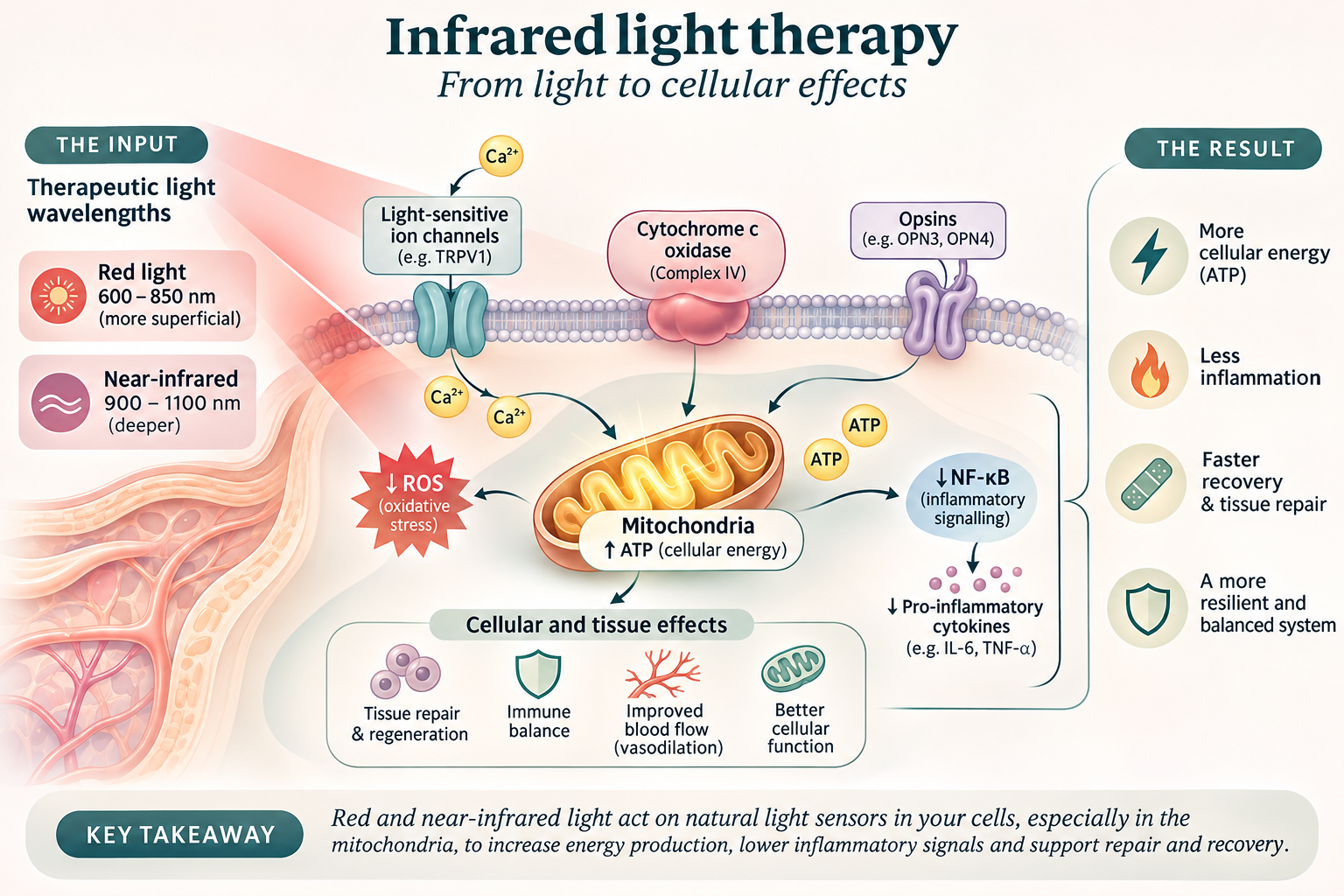
The method, also known as photobiomodulation (PBM), works with red (600 to 700 nm) and near infrared (700 to 1200 nm) light. Research shows it can reduce inflammation, and it is being studied for a range of other applications.
Below you find an overview of how it works in your body and what the research shows.
-
Red and near infrared light calms immune cells called macrophages, shifting them from an inflammatory to a repairing mode. It lowers inflammatory messengers such as IL-1β and raises the anti-inflammatory messenger IL-10 [1, 2, 3]. In people with obesity, a meta-analysis of 11 randomised trials found lower CRP, a blood marker of inflammation [4].
-
Red and near infrared light is absorbed by your mitochondria, the power plants of your cells. More cellular energy (ATP) is one of the most consistent findings in PBM research [5]. In stressed or damaged cells, PBM lowers oxidative stress [1]. The dose matters: too little does nothing and too much suppresses the effect, which is why sessions are kept short [5].
-
PBM supports wound healing by stimulating new blood vessels and tissue repair [1]. In people with diabetic foot ulcers, more wounds healed completely with light therapy than without [6]. In chronic pain, randomised trials show the clearest benefit in fibromyalgia and nerve pain [7]. A full body panel reduced pain in women with fibromyalgia for up to six months [8].
-
In a controlled trial with 136 adults, 30 sessions of red light increased collagen density and reduced fine lines, wrinkles and skin roughness [9]. Reviews confirm benefits for skin rejuvenation and repair [10].
-
Applied before exercise, red and near infrared light increased the number of repetitions and the time until exhaustion, with signs of faster muscle recovery [11, 12]. Research with full panels is ongoing [13].
-
A meta-analysis of 11 randomised trials found that PBM moderately reduced symptoms of depression [14]. The effect came mostly from light applied to specific points on the body. PBM is a complement to psychological or medical treatment, not a replacement.

Device specifications
-
600 LEDs with two light sources each, 1200 in total. The panel is 180 cm long and 30 cm wide, so it covers your whole body at once.
-
A high intensity therapeutic device. That is why a shorter exposure of 20 minutes is enough for a therapeutic effect of around 35 mW/cm2 at 20cm distance.
-
630 nm reaches the outer layers of the skin and supports wound healing, collagen production and skin texture.
660 nm reaches a little deeper. It supports cell regeneration, reduces inflammation and improves circulation in your tissues.
810 nm penetrates deep into tissue, acts directly on muscles and nerves, and improves cellular energy production and regeneration.
850 nm also penetrates deeply, which makes it well suited for joints, deep muscles, nerve function and pain relief.
-
A narrower beam angle concentrates the light on a smaller area. That gives a higher light intensity and a stronger effect at the right distance, which benefits muscle recovery, joint pain and other applications that need a high dose of light.
Prices
1 session = 45 minutes
Single session:
CHF 75
10 sessions:
CHF 700
20 sessions:
CHF 1250
How many sessions?
A single session can be a pleasant, revitalising experience: after an intense working week, to recover from training, or to prepare for a demanding event.
A course of sessions supports more lasting effects, such as better energy production, improved mood and less inflammation.
Where it may help
As part of a broader treatment plan, research supports infrared therapy for:
Chronic pain, such as fibromyalgia and nerve pain [7, 8]
Chronic low back pain [15]
Slow healing wounds, such as diabetic foot ulcers [6]
Skin rejuvenation: fine lines, wrinkles and skin texture [9, 10]
Sport performance and muscle recovery [11, 12]
Mood disorders, as a complement to treatment [14]
References
Hamblin MR. Mechanisms and applications of the anti-inflammatory effects of photobiomodulation. AIMS Biophys. 2017;4(3):337-61. doi:10.3934/biophy.2017.3.337
Liao W, Hung C, Liang S, Yu S, Lu J, Lee C, et al. Anti-inflammatory effects induced by near-infrared light irradiation through M2 macrophage polarization. J Invest Dermatol. 2021;141(8):2056-66.e10. doi:10.1016/j.jid.2020.11.035
Shamloo S, Defensor E, Ciari P, Ogawa G, Vidano L, Lin JS, et al. The anti-inflammatory effects of photobiomodulation are mediated by cytokines: evidence from a mouse model of inflammation. Front Neurosci. 2023;17:1150156. doi:10.3389/fnins.2023.1150156
Sun W, Zhuang Z, Yang L, Zhou J, Zhang L, Yuan J. Effectiveness of photobiomodulation therapy in improving health indicators in obese patients: a systematic review and meta-analysis of RCTs. BMC Complement Med Ther. 2025;25(1):133. doi:10.1186/s12906-025-04874-2
de Freitas LF, Hamblin MR. Proposed mechanisms of photobiomodulation or low-level light therapy. IEEE J Sel Top Quantum Electron. 2016;22(3):7000417. doi:10.1109/JSTQE.2016.2561201
Wang HT, Yuan JQ, Zhang B, Dong ML, Mao C, Hu D. Phototherapy for treating foot ulcers in people with diabetes. Cochrane Database Syst Rev. 2017;6(6):CD011979. doi:10.1002/14651858.CD011979.pub2
Ferreira LMA, Oliveira ABC, Mendes JJB, Costa GV, Silva IR, Santos GN, et al. Photobiomodulation in chronic pain: a systematic review of randomized clinical trials. Front Integr Neurosci. 2026;20:1717372. doi:10.3389/fnint.2026.1717372
Navarro-Ledesma S, Carroll JD, González-Muñoz A, Burton P. Outcomes of whole-body photobiomodulation on pain, quality of life, leisure physical activity, pain catastrophizing, kinesiophobia, and self-efficacy: a prospective randomized triple-blinded clinical trial with 6 months of follow-up. Front Neurosci. 2024;18:1264821. doi:10.3389/fnins.2024.1264821
Wunsch A, Matuschka K. A controlled trial to determine the efficacy of red and near-infrared light treatment in patient satisfaction, reduction of fine lines, wrinkles, skin roughness, and intradermal collagen density increase. Photomed Laser Surg. 2014;32(2):93-100. doi:10.1089/pho.2013.3616
Hernández-Bule ML, Naharro-Rodríguez J, Bacci S, Fernández-Guarino M. Unlocking the power of light on the skin: a comprehensive review on photobiomodulation. Int J Mol Sci. 2024;25(8):4483. doi:10.3390/ijms25084483
Leal-Junior ECP, Vanin AA, Miranda EF, de Carvalho PTC, Dal Corso S, Bjordal JM. Effect of phototherapy (low-level laser therapy and light-emitting diode therapy) on exercise performance and markers of exercise recovery: a systematic review with meta-analysis. Lasers Med Sci. 2015;30(2):925-39. doi:10.1007/s10103-013-1465-4
Vanin AA, Verhagen E, Barboza SD, Costa LOP, Leal-Junior ECP. Photobiomodulation therapy for the improvement of muscular performance and reduction of muscular fatigue associated with exercise in healthy people: a systematic review and meta-analysis. Lasers Med Sci. 2018;33(1):181-214. doi:10.1007/s10103-017-2368-6
Ghigiarelli JJ, Fulop AM, Burke AA, Ferrara AJ, Sell KM, Gonzalez AM, et al. The effects of whole-body photobiomodulation light-bed therapy on creatine kinase and salivary interleukin-6 in a sample of trained males: a randomized, crossover study. Front Sports Act Living. 2020;2:48. doi:10.3389/fspor.2020.00048
Ji Q, Yan S, Ding J, Zeng X, Liu Z, Zhou T, et al. Photobiomodulation improves depression symptoms: a systematic review and meta-analysis of randomized controlled trials. Front Psychiatry. 2024;14:1267415. doi:10.3389/fpsyt.2023.1267415
Glazov G, Yelland M, Emery J. Low-level laser therapy for chronic non-specific low back pain: a meta-analysis of randomised controlled trials. Acupunct Med. 2016;34(5):328-41. doi:10.1136/acupmed-2015-011036