
Psychoneuroimmunology
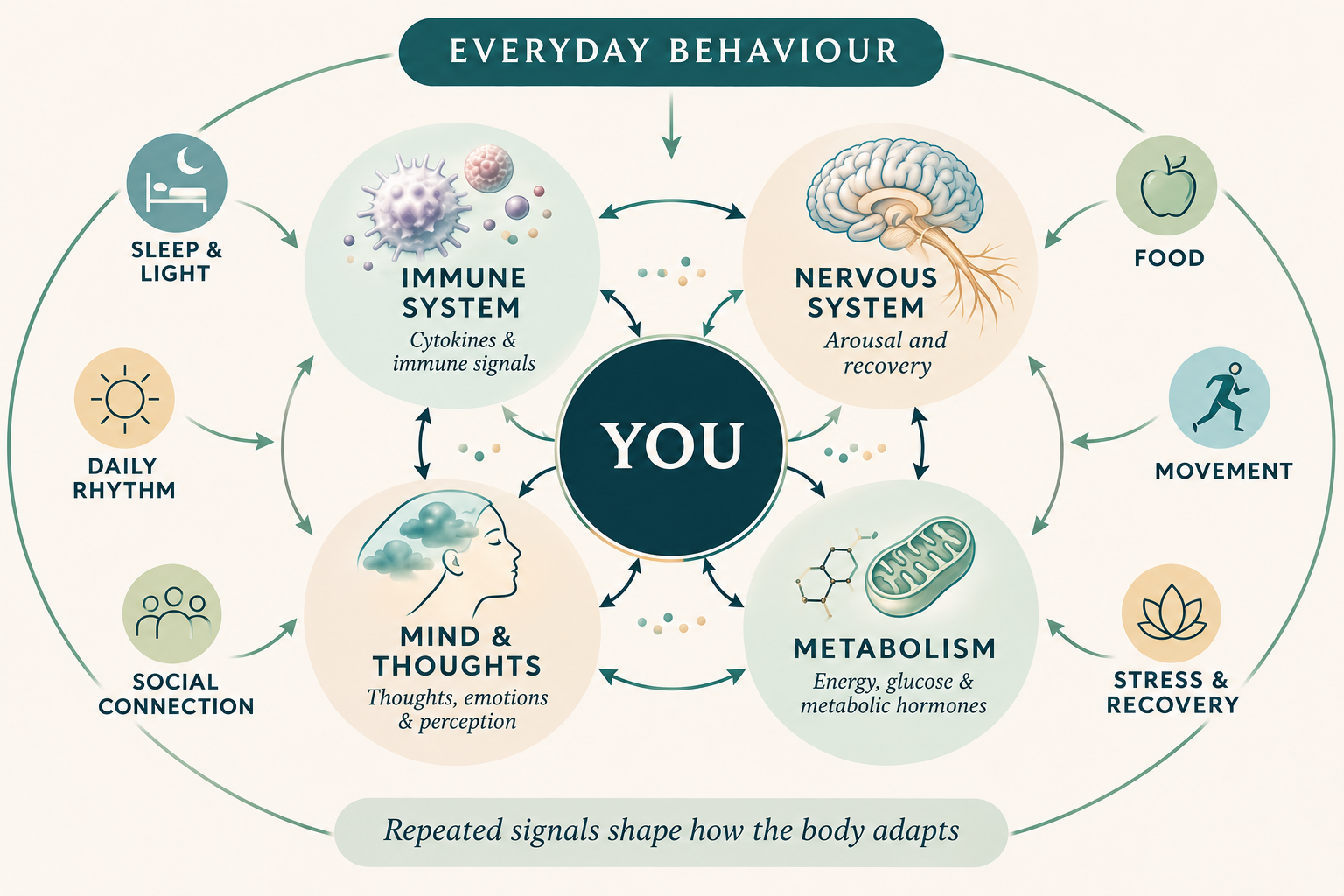
Psychoneuroimmunology (PNI) is the science of how your mind, nervous system, hormones and immune system work together. Your physiology is always listening, and it is trained by what you expose it to. I use PNI to understand what your body has learned, and to find out with you what helps it recover.
Your mind and body, one system
What PNI is
PNI has been a research field since the 1970s, with its own international society (PNIRS), a European network (EPN), postgraduate education (Pruimboom Institute) and its own journal, Brain, Behavior, and Immunity. Universities such as Kings College London, UCLA, Ohio State, Karolinska Institute, Carnegie Mellon and the University of Pittsburgh have dedicated PNI centres and research groups. I use that research to guide my clinical decisions and to support you.
An approach that sees your whole physiology as one system. Stress changes your immune system, and your immune system changes how you feel, think and sleep. That is why physical and emotional symptoms are rarely two separate problems.
Your physiology is always listening
Your body constantly adapts to the signals you give it: light, food, movement, sleep, stress, safety and the people around you. Whatever you expose it to every day, it gets trained on.
Our systems evolved for short challenges followed by recovery. Modern life sends signals that never resolve: long hours of sitting, screens at night, constant availability, worries without an end. Stress hormones lose their rhythm, the nervous system stays on the accelerator and the immune system stays on low alert.
The good news follows from the same principle: what was trained can be retrained, step by step.
How I assess your system
Your history. Our first session is mostly you talking and me listening. We look at today, and we look back: what the recent years looked like, what you went through, how you have handled pressure over the years. Your nervous and immune systems were shaped by that history, often from childhood on.
Your physiology. I don't hand out a diet or an exercise schedule. I look at what your sleep, food, movement and relationships do to your body. Poor sleep can push your immune system towards inflammation, raise your stress tone and lower testosterone. Too little movement and ongoing pressure keep your nervous system on the accelerator.
Down to the cells. I also look at how well your cells produce energy, and how that links to fatigue and brain fog.
Your thinking. Sometimes the most important work is psychological. How you see yourself, the world and other people shapes your physiology as much as food or sleep does. Take exercise for anxiety: the workout matters less than what it does for your sense of self worth.
My training included modules in psychology and acceptance based therapy, and I trained in cognitive behavioural therapy for insomnia (CBT-I). I am not a psychotherapist, but I use elements of these approaches where they fit.
You are the expert on your own life. I bring the science. Together we turn it into a plan that fits your life.
How I measure
Heart rate variability (HRV) shows how your autonomic nervous system balances stress and recovery.
Biofeedback shows, live, how your body responds to specific regulation exercises. That way we find out what works for you, not what works on average.
Bloodwork ranges from immune parameters to metabolic markers and hormones.
Questionnaires assess where you start and monitor how you progress.
How we work together
1. Listen. Your story, in your words.
2. Map and measure. We connect your symptoms to the systems behind them.
3. Plan. Short term interventions with the best return of investment and long term adaptations.
4. Review. We measure again and adjust. What works stays.
I work alongside your GP, psychiatrist or psychotherapist, and refer you on when we see fit.
Ready to be heard?
Tell me what's going on. In a short discovery call we find out together whether this approach fits you.
Read more about burnout, depression and chronic stress.